- HOME
- Sustainability
- Respect for Human Rights
Respect for Human Rights
Basic Approach to Respecting Human Rights
For human rights issues, we have formulated the “SCB Group Human Rights Policy” and commit to meeting the responsibility of a business enterprise to respect human rights. We conduct our business operations bearing in mind the impacts of our business activities on human rights.
In addition, we also expect our customers and suppliers to respect human rights in accordance with this Policy.
Organizational Structure to Promote Respect for Human Rights
Policies regarding sustainability, including respect for human rights, are discussed at the Executive Committee and then resolved at the Board of Directors. The progress of initiatives based on the policies of the Board of Directors is discussed at the Executive Committee and reported to the Board of Directors at least once a year.
In addition, from the standpoint of integrated management as one banking group, we hold the “Group Sustainability Promotion Committee” meetings twice a year, a committee comprised of President and CEO as well as the Director in charge of Sustainability Promotion Division of the SCB and group company presidents to discuss such matters as the SCB Group’s policies and initiatives regarding sustainability including respect for human rights.
Initiatives for sustainability, including respect for human rights, are being taken cross-organizationally, with the Sustainability Promotion Division playing a central role.
Dissemination and Raising Awareness of Human Rights Policy
We conducted training on human rights initiatives for our employees to ensure compliance with and steady promotion of this Policy.
In addition, to improve and enhance efforts by external stakeholders for human rights and to promote and raise their awareness of human rights issues, we conducted training for shinkin banks on sustainable management, including respect for human rights.
Going forward, through dialogue with stakeholders, we will continue to seek understanding on the SCB Group’s approach to human rights.
Human Rights Due Diligence
The SCB engages in human rights due diligence by adhering to the United Nations Guiding Principles on Business and Human Rights to prevent and mitigate adverse human rights impacts.
In view of the SCB’s business environment, we identified the human rights issues and assessed them based on the severity of impact and likelihood of occurrence, then created a map of these human rights issues to identify issues to be addressed first (February 2024).
Based on the results, we are deliberating with relevant divisions on future policies to address these human rights issues. The human rights issue map will be revised on a periodic basis in view of changes to the business environment, etc.
Each company in the SCB Group is also working to identify and assess adverse human rights impacts and to collect information about the status of measures to prevent and mitigate such impacts as part of its human rights due diligence.
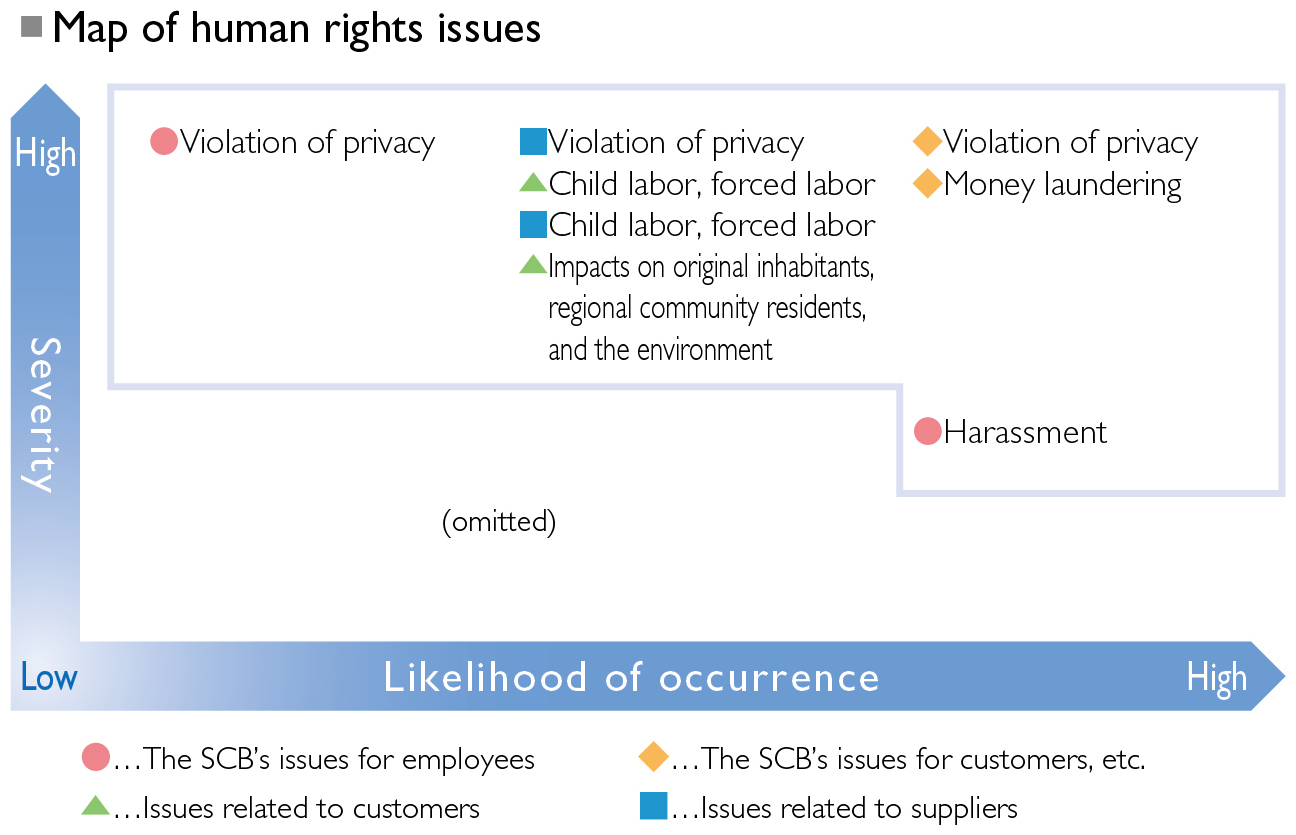

The SCB is working on the following initiatives to prevent and mitigate adverse human rights impacts.
It also conducts evaluation of effectiveness of the initiatives.
The SCB’s Initiatives for Employees
To prevent harassment, we have raised awareness through training and other means, as well as conducting regular interviews between employees in each division and Personnel Division staff to understand the workplace environment and resolve issues.
For health of employees, we introduced a system to control long working hours by establishing “no-overtime days” and prohibiting work after 9 p.m. In addition, we have various measures to promote the use of paid leave, and in fiscal 2024, we established a new “premium leave” (a system for taking paid leave for three consecutive business days).
In addition, to prevent health problems caused by overwork, we take measures to provide medical examinations, etc. to employees who work long hours.
The SCB’s Initiatives for Customers, Etc.
To prevent violation of privacy, we published “Declaration of Personal Information Protection” on the handling of personal information and established specific management methods in our personal information management rules and bylaws, thereby establishing a system required of businesses handling personal information and process related to individual numbers.
We provide training for officers and employees on how to handle personal information properly.
We recognize that the products and services we provide could be used for money laundering and other activities that could lead to adverse human rights impacts, and we are committed to preventing money laundering, financing of terrorism, and counter proliferation financing.
Initiatives Related to Customers
In the framework of credit screening, the impact of ESG factors on the creditworthiness of customer is qualitatively evaluated, and credit decisions are also made on the evaluation results.
Based on the Equator Principles, we assess the environmental and social impacts of projects in the decision-making process on project finance, etc., and continuously monitor the status of environmental and social considerations even after the project has been put into operation.
As improvements are made to the operation of the national technical intern training system and specified skilled worker system, the SCB collaborates with organizations sending workers from abroad to conduct seminars so that shinkin banks’ customers can use foreign human resources in a way that respects human rights.
Initiatives Related to Suppliers
In selecting outside contractors, we evaluate their commitment to the SDGs including human rights.
In addition, when investing in funds, we evaluate the ESG investment stance of the entrusted asset management company and make investment decisions based on the evaluation results.
When outsourcing the handling of personal data, etc. to outside vendors, etc., we check their personal data management system, etc. to prevent any violation of privacy, and provide appropriate supervision on the security management of the entrusted personal data, etc.
Grievance Mechanism
The SCB Group is committed to establishing a system to respond appropriately to comments and complaints on human rights.
[Internal reporting & consultation systems]
We have a “compliance hotline system” to enable officers and employees who detect compliance violations to report directly to the compliance supervisory division or a corporate lawyer.
Moreover, we are making employees aware of the system through various training programs, etc. and working to detect compliance violations at an early stage by encouraging the active use of the system.
In addition to having a person in charge of receiving complaints and consultation regarding harassment, we also provide employees the opportunity to consult with a full-time outside counselor.
[Contact for consultation and requests]
We actively collect customer requests on products and services received at sales branches and at our headquarters, and respond to them promptly and courteously, while striving to utilize the collected requests and other information in our business operations.